ads
What Seems Innocent Can Cost You Dearly
Opening a dating app is, at its core, an act of hope. You create a profile, choose your best photos, and put yourself out there with the possibility of finding someone special. But there’s a side to this experience that very few people stop to seriously consider: the amount of personal information circulating on these platforms every single day, handed over voluntarily and without any real criteria.
The excitement of a new conversation makes people share far more than they should — and far sooner than they should. A photo here, a neighborhood address there, a phone number shortly after. Each piece of information seems harmless on its own. Together, they form a detailed map of your life.
This article goes beyond generic advice. Here you’ll understand exactly which types of information are dangerous, why they’re dangerous, and how to truly protect yourself — without sacrificing the authenticity that makes online connections genuine.
Messages: What You Type Can Be Used Against You
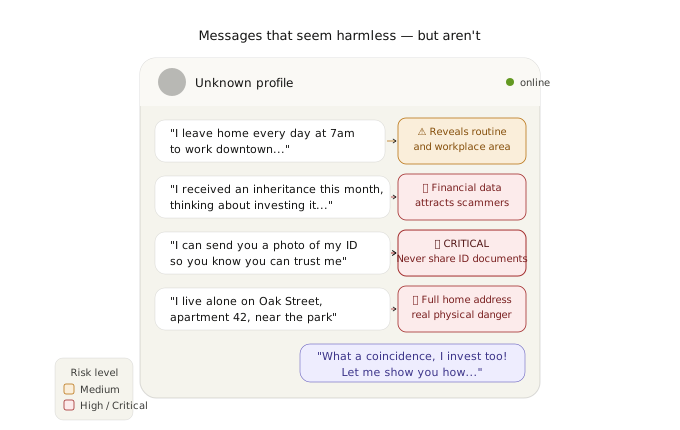
- Financial information: never mention your bank, investments, savings, or any detail that signals your financial situation. Scammers behind pig butchering — one of the most sophisticated schemes of recent years — spend weeks building emotional bonds specifically to capture this type of data before presenting an “exclusive investment opportunity.”
- Daily routine details: phrases like “I leave home every day at 7am,” “I work in this neighborhood,” or “every Friday I go to this place” build a complete behavioral map over the course of a conversation — one that can be used in financial scams or stalking situations.
- Personal identification documents: Social Security number, driver’s license, and passport should never be shared under any circumstances. No legitimate situation on a dating app requires identification documents. If someone asks, end the conversation immediately.
- Deep emotional vulnerabilities shared too early: traumas and emotional fragilities disclosed too soon can be used to create dependency and emotional manipulation. Real intimacy is built with time and proven trust — not with speed.
- Full name right at the start: your first name is enough to begin. Full name combined with city and profession is already enough for someone to locate you across social networks within seconds.
Photos: Far More Than Meets the Eye
- Location metadata embedded in images: invisible to the naked eye, but any basic EXIF reader app can extract the exact GPS coordinates of where a photo was taken. Disable this feature before sending any image — especially ones taken at home, work, or places you frequent regularly.
- Intimate or suggestive photos: sextortion — extortion based on intimate images — is growing rapidly across the world. The rule here is non-negotiable: never send intimate images to people you haven’t met in person and don’t deeply trust.
- Photos that reveal your location indirectly: your house facade in the background, a restaurant name clearly visible, a company logo on the wall behind you — each detail, crossed with information from the conversation, can reveal exactly where you are.
- Photos of children: your kids, nieces, nephews, or any minor should never appear in images shared with strangers on dating platforms. Beyond the obvious safety risks, these images can be used in ways no adult can fully anticipate.
- Visible license plate: your vehicle plate can be used to track your residential address through publicly available lookup services. A detail that seems completely irrelevant can directly expose where you live.
Location: The Most Dangerous Data of All
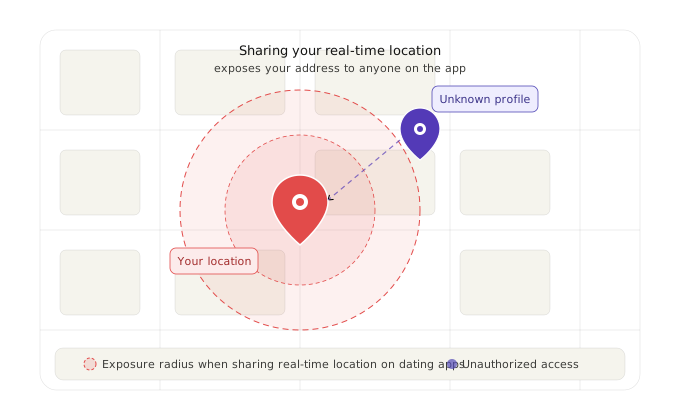
- Real-time location should never be shared with someone you met online and haven’t yet met in person — regardless of how safe the conversation feels or how much you think you trust the person.
- Home address is a line that should never be crossed before a consolidated in-person meeting. Even your neighborhood name deserves caution — combined with other details from the conversation, it can be enough for a determined person to find you.
- Workplace: your company name, combined with your photo and departure time, creates a situation where someone could approach you in a context where you have no control and no preparation.
- First meeting location: always choose somewhere public, busy, and selected by you. Never allow a first meeting to happen at your home or the other person’s home — this rule has no exceptions.
- Real-time check-ins and stories: posting your location on social media while you’re still there is the digital equivalent of announcing where you are. Post after you leave, never during.
Scams That Exploit Exactly These Vulnerabilities
Catfishing with extortion: starts with an attractive profile and quickly escalates to exchanging intimate photos. Once the images are obtained, the scammer reveals their real intention — pay up or the photos get sent to your family, friends, and coworkers.
Financial romance scam: the scammer invests weeks or months building a genuine emotional relationship before introducing any financial element. Once trust is established, the “opportunity” appears — an investment, an emergency, a debt. Billions of dollars are lost to this scam every year around the world, affecting smart, emotionally balanced people.
Digital and physical stalking: routine, location, and workplace details are quietly recorded throughout the conversation. What starts as a pleasant chat can end in an uninvited encounter somewhere you’d be “by coincidence.”
How to Protect Yourself Without Losing Your Authenticity
- Keep the conversation on the app for as long as possible. Native platform chats have logged history and reporting mechanisms that WhatsApp simply doesn’t offer once you move off-platform.
- Disable location metadata. On iPhone: Settings > Privacy > Location Services > Camera > Never. On Android: open Camera > Settings > disable the location saving option.
- Reverse image search before investing emotionally. Google Images and TinEye identify stolen profile photos within seconds — make it a habit before any real conversation begins.
- Ask for a video call early — keep it natural, not an interrogation. Something simple like “it’d be nice to actually see you before we keep chatting” works perfectly. Anyone with nothing to hide will accept without hesitation.
- Tell someone you trust where you’ll be for a first meeting, who you’re meeting, and what time you plan to be back. This simple step provides real safety with no awkwardness.
When Something Has Already Happened
Block on every platform and document everything with screenshots before you do. File a police report — in most US states this can be done online or at your local precinct. For intimate image cases, many states have specific laws criminalizing non-consensual sharing of private images. Organizations like the Cyber Civil Rights Initiative (cybercivilrights.org) offer direct support and legal resources for victims. Act quickly — time matters when it comes to containing damage.
Genuine Connections Deserve to Be Protected
Your safety isn’t an obstacle to genuine connections — it’s the foundation on which they need to be built. When you build trust with criteria and with time, what forms is far more solid and far more real than any artificially accelerated intimacy could ever be. People with good intentions won’t mind your caution. Those who do mind were counting on your lack of it.