Anúncios
Did you know a foreign transaction fee usually goes from 1% to 3% on overseas buys?
Buying things abroad or online from another country adds a noticeable fee to your bill.
FX fees or foreign exchange fees are different from the costs of changing currency rates.
Before traveling, find out if companies like Capital One don’t charge these fees. This way, you can dodge extra costs.
Many banks charge a foreign transaction fee. It helps them handle the costs of using cards in other countries.
These fees are often 1% to 3% for buying things. Taking cash from ATMs might cost up to 3.5% in places like Canada.
To know the fee, just multiply what you spent by the bank’s percentage. You’ll see the extra cost right away.
Dynamic currency conversion can raise the price. Paying in the local money usually costs less than if the seller changes it.
For those from the U.S., knowing your card’s policy can help. Pick a card that drops these fees to save more.
Understanding the Concept: foreign transaction fee explained
When you buy something in another currency, your bank may charge a foreign transaction fee. This is typically 1% to 3% of what you spend. It might be listed as an international transaction fee or an overseas transaction fee on your statement.
Banks first charged this fee to cover costs and protect against currency changes. Although technology has made these processes cheaper, many banks still charge this fee. It’s a way for them to make extra money.
However, some companies like Capital One and Discover don’t charge this fee. Charles Schwab checking accounts also skip it. Always check your card’s policy before traveling to avoid surprises.
Anúncios
Anúncios
It’s easy to mix up the bank’s FX fee with the poor exchange rates some stores offer. Stores might suggest paying in U.S. dollars using dynamic currency conversion, but this can lead to worse rates. You’re usually better off letting your bank handle the currency conversion.
| Item | Typical Range | Who Applies It |
|---|---|---|
| Foreign transaction fee | 1%–3% | Card issuers (credit, debit, some prepaid) |
| International transaction fee | 1%–3% | Issuer wording varies; same mechanics |
| Overseas transaction fee | 1%–3% | Appears on statements when merchant is foreign |
| FX fee | 1%–3% (plus rate spread possible) | Issuer charge plus network conversion impacts |
Check your card’s terms and your statements to see if they charge a foreign transaction fee. This fee is often a percentage of what you spent, converted to U.S. dollars. It’s easy to find and compare with other cards.
Old Way versus New Way: how international payment handling has changed
In the past, banks handled international payments by hand. This process took a lot of work and often had mistakes. You would usually see a fee on your bill for transactions from another country.
Credit card companies would add extra charges, too. These fees could increase your purchase cost by 2% to 3%. Also, stores often converted prices to your currency at the register. Unfortunately, this usually meant you got a worse exchange rate than what your credit card offered.
Today, things are different thanks to networks like Visa and Mastercard. They have made processing these payments much quicker and cheaper. Now, the cost of converting currency is more predictable too.
Card companies have had to compete more. Because of this, some, like Capital One and Discover, don’t charge a foreign transaction fee on many of their cards. This change means you have better choices for avoiding extra fees when buying things from another country.
But some old practices are still around. For example, stores might still offer to convert the price to your currency at the register. This is usually not the best deal for you. It’s best to say no to this offer and make sure they bill you in the local currency.
To get the best exchange rate, use a card that doesn’t charge for foreign transactions. Say no to the store’s offer to convert the price. Even today, the choice of card and whether you accept certain services can affect how much you really pay compared to the official exchange rate.
| Aspect | Old Way | New Way |
|---|---|---|
| Settlement method | Manual, slower processing | Automated network processing (Visa, Mastercard, AmEx) |
| Customer charges | Cross-border transaction fee plus issuer surcharges (2%–3%) | Many cards waive foreign transaction fee; network rates standardized |
| Merchant behavior | Widespread dynamic currency conversion offers | DCC still available as an upsell; reject to avoid poor rates |
| Typical outcome for traveler | Higher total cost from combined fees and DCC | Lower backend fees but merchant practices can add currency conversion fee |
| Practical tip | Watch for DCC and ask to be billed in local currency | Choose no-foreign-fee cards from issuers like Capital One or Discover |
Workflow: steps to identify and calculate foreign transaction fees
First, look at your card’s terms and find the foreign transaction fee percentage. It’s usually between 1% and 3%. Keep this percentage in mind for later calculations.
Next, check what kind of transaction you’re dealing with. See if the merchant is overseas or if you’re being charged in a foreign currency. These situations could lead to an additional fee for international transactions, even on purchases from websites outside the U.S.
Then, find out who did the currency conversion. It could be Visa, Mastercard, or American Express, or maybe the merchant offered to do it during checkout. This choice changes how the fee is calculated and listed on your bill.
To figure out the fee, change the percentage to a decimal and multiply it by the charge’s value in U.S. dollars. For instance, a 3% fee on a $50 purchase equals $1.50. Add this fee to your purchase cost to see the full amount, and check if the fee is shown separately.
After the charge shows up, look over your statement closely. Confirm how fees from the merchant, currency conversion, and any ATM fees are displayed. If something doesn’t look right, talk to your card issuer quickly to fix any mistakes or wrong charges.
Before you travel, take steps to avoid these fees. If your card has a foreign transaction fee, think about getting a card that doesn’t charge one. Also, let your card issuer know about your travel plans. This helps prevent security blocks on your card and makes dealing with foreign fees easier later on.
| Step | Action | Why it matters |
|---|---|---|
| 1 | Check card terms and disclosures | Confirms the issuer’s percentage used in FX fee calculation and whether an international transaction fee applies |
| 2 | Identify transaction type | Determines if merchant location or currency will trigger the fee |
| 3 | Determine network conversion | Shows whether network or merchant conversion affects the final amount |
| 4 | Calculate the fee | Gives the exact dollar cost using the issuer percentage for accurate budgeting |
| 5 | Review statement details | Helps spot ATM operator fees and disputed international transaction fee entries quickly |
| 6 | Plan preventive action | Reduces future fees by choosing no-foreign-fee cards and notifying issuers of travel |
Key Options: cards and tools comparison
When you’re planning to spend abroad, you have some clear options. Cards that don’t charge a foreign transaction fee are offered by companies like Capital One and Discover. These cards help you avoid the usual 1% to 3% charge per purchase. Plus, they often offer travel rewards and protections for your purchases.
If you need cash overseas, certain debit accounts make it easier. For example, Charles Schwab Checking gives back money spent on international ATM fees. It also doesn’t charge extra for foreign debit transactions. This makes it a good choice if you like having local currency in your pocket.
Prepaid travel cards are perfect for keeping to a budget. You put money on them before you go, which means no surprise costs. But, be careful of extra fees for adding more money or not using the card. These fees can lessen their benefits.
| Card type | Typical issuers | Primary benefit | Common drawback |
|---|---|---|---|
| Travel credit cards no foreign transaction fee | Capital One, Discover, Chase Sapphire | Rewards points, no FX fee on purchases | Annual fee on premium variants |
| Debit accounts reimbursed ATM fees | Charles Schwab, Ally (select accounts) | Cash access with fee reimbursement | Less rewards, possible ATM limits |
| Prepaid travel cards | VISA/ MasterCard branded travel cards | Controlled spending, locked exchange rate | Reload fees, limited protections |
| Standard consumer cards that charge foreign transaction fees | Many regional banks and older cards | Often lower or no annual fee at home | Cards that charge foreign transaction fees add 2.5%–3% abroad |
Think about how much you buy from other countries, your cash needs, and if rewards cover any yearly fees. For those who travel a lot, a rewards card without foreign fees usually is worth it. If cash is your go-to, choose an account that gives back ATM fees.
Watch out for merchant tricks. Even the best cards might get you a bad exchange rate through dynamic currency conversion. To avoid this, don’t opt for DCC. This ensures you get your issuer’s exchange rate. This tip keeps the benefits of no-fee cards and prepaid cards when used right.
Check the table above to see what fits your spending habits. Pay attention to fees, what protection they offer, and their convenience. This helps you pick the best option for trips and buying things in foreign currencies online.
Dynamic Currency Conversion and merchant tactics
When you’re abroad, merchants might offer to charge your purchase in U.S. dollars. This is known as dynamic currency conversion. It seems handy, but you might end up paying more compared to letting your card network convert the amount.
What DCC is and why it matters
Dynamic Currency Conversion (DCC) allows merchants to convert your bill into your home currency right away. The exchange rate is set by the merchant or the terminal, and it’s often higher than the rates Visa, Mastercard, or American Express would offer.
This service could lead to paying a conversion fee twice. First, because of DCC’s added markup, and second, your card issuer might charge you another foreign transaction fee. This combination often makes DCC more expensive than standard network conversions.
So, when given the option of charging in U.S. dollars, always choose the local currency instead. Card networks usually provide better rates than what you’d get with DCC, helping you save on markups.
If you’re unsure, ask the merchant for their exchange rate and compare it with your card network’s rate. You can find this in your card issuer’s app or on their website. If the merchant’s rate is higher, it’s better to say no to DCC. This way, you avoid extra fees.
Dynamic Currency Conversion and merchant tactics
When you spend money abroad, some stores might offer to charge you in dollars. This seems handy, but it usually comes with extra fees. Know what to do at payment machines and online to keep your money safe.
Quick actions at the terminal
Insist on paying with the local currency at the checkout. Make sure the machine shows the amount in the local currency. If it tries to charge you in dollars, say no kindly. Then ask again to be charged in the local money.
What to check on a printed receipt
If a store gives you a receipt with DCC, check their exchange rate against a reliable source, like what your card offers. Figure out the difference on the spot. If their rate is much higher, don’t accept DCC. Instead, ask to be charged again in the local currency.
Card choice and issuer fees
Choose cards that don’t charge extra for international purchases to save money. Even with these cards, refuse DCC. This way, you avoid bad exchange rates plus the added cost of fees.
Online checkout and contactless payments
When shopping online, check if you can pay in the local currency before finishing your purchase. If the website tries to make you pay in dollars, change it. Or, use a tool that converts currencies. For tap-and-go or phone payments, make sure DCC wasn’t automatically chosen.
Practical habit checklist
- Always ask to pay in the local currency before authorization.
- Decline DCC if the terminal offers a U.S. dollar charge.
- Verify printed exchange rates and decline DCC when rates exceed market norms.
- Use cards without foreign transaction fees to avoid compounding costs.
Foreign transaction fee versus currency conversion fee: differences and overlap
When you buy something from another country, two kinds of fees can appear. A foreign transaction fee is what your card issuer charges. A currency conversion fee is added by the payment network to change the purchase into dollars.
Issuer fee versus network conversion
Issuers usually charge between 1% and 3% of each transaction. On top of that, the payment network might add about 1% more.
These fees might show up together as an “FX” charge on your bill. It’s tricky to figure out where each cost comes from just by looking. You need to check your card’s details to understand.
Some bank cards, like those from Capital One for travelers, don’t charge these fees. It’s good to know your card’s fees before spending in another country.
Here’s a tip: if a seller offers to charge you in your currency, say no. Letting the issuer or network do the currency change could save you money. It usually works out cheaper than the store’s conversion rate.
Foreign transaction fee versus currency conversion fee: differences and overlap
When you buy something in another country, you might notice a few charges. First, the shop lists the price in their money. Then, your card converts this to U.S. dollars. Finally, your bank might add a fee for handling a foreign purchase. This fee could be shown separately or included in the total price you see.
Reading the lines
There are three key things to look out for. These are the original price in the shop’s currency, how much that is in dollars after the card network has changed it, and any extra fee for the foreign transaction. Some banks specify this extra charge either as a percentage or a flat dollar rate.
Example you can check
Let’s say you spent €45, and your card changes that to $51. Then, your bank adds a 3% fee. This fee comes out to $1.53. So, you might see $51 plus a $1.53 fee on your bill, totaling $52.53. However, some banks might just show one total amount, saying $52.53, without breaking it down.
When amounts seem off
If the numbers don’t look right, compare them. Look at the shop’s price and what your bank says it became in dollars. Hold onto receipts with the original price. Also, check if you got a special receipt showing the shop converted the price differently.
Dispute steps
If you see a charge that doesn’t make sense, call your bank fast. Ask them to clarify how they list fees and show conversions. If their answers are not clear, ask for a written breakdown. This helps you check the numbers yourself.
| Statement line | What it shows | Why it matters |
|---|---|---|
| Merchant currency amount | Price in local currency, e.g., €45 | Confirms what you were charged at point of sale |
| Network conversion | Converted U.S. dollar amount, e.g., $51 | Shows the exchange rate applied by Visa, Mastercard, or others |
| Foreign transaction fee statement | Issuer fee listed separately, e.g., $1.53 | Reveals the additional cost charged by your bank |
| Combined total | Single posted charge, e.g., $52.53 | May hide the FX markup unless issuer provides a breakdown |
Impact on travel budgets: data-driven examples
When you travel, little costs like meals, taxis, or museum entries seem minor. But, adding a foreign transaction fee and FX fee calculation across your trip can quickly increase your spending.
Here are straightforward examples to show how fees can change your budget. They detail the fee, total cost, and the basic math of international transactions.
Sample calculations
Example 1 — small purchase: Buying a dinner for $50 with a 3% issuer fee adds $1.50. So, the dinner costs $51.50. This shows how even small buys can add to your travel costs.
Example 2 — typical trip spend: Spend $1,000, and with a 3% fee, you’re paying $30 extra. It’s a simple way to see what you might spend on a longer trip.
Example 3 — combined charges: Imagine a card network adds 1% and the issuer adds 2%. For a $500 purchase, you pay $15 in fees. This shows how fees stack up.
Comparative scenario — no-foreign-fee card: If you remove the 1%–2% issuer fee, you save up to $30 on a $1,000 spend. Not using DCC avoids extra merchant markups. This comparison helps pick the best payment option for your travels.
| Scenario | Purchase | Issuer Fee | Network/ Merchant Markup | Total Fees | Final Cost |
|---|---|---|---|---|---|
| Small purchase | $50 | 3% ($1.50) | 0% ($0.00) | $1.50 | $51.50 |
| Typical trip | $1,000 | 3% ($30.00) | 0% ($0.00) | $30.00 | $1,030.00 |
| Combined charges | $500 | 2% ($10.00) | 1% ($5.00) | $15.00 | $515.00 |
| No foreign fee card | $1,000 | 0% ($0.00) | 1% ($10.00) | $10.00 | $1,010.00 |
Impact on travel budgets: data-driven examples
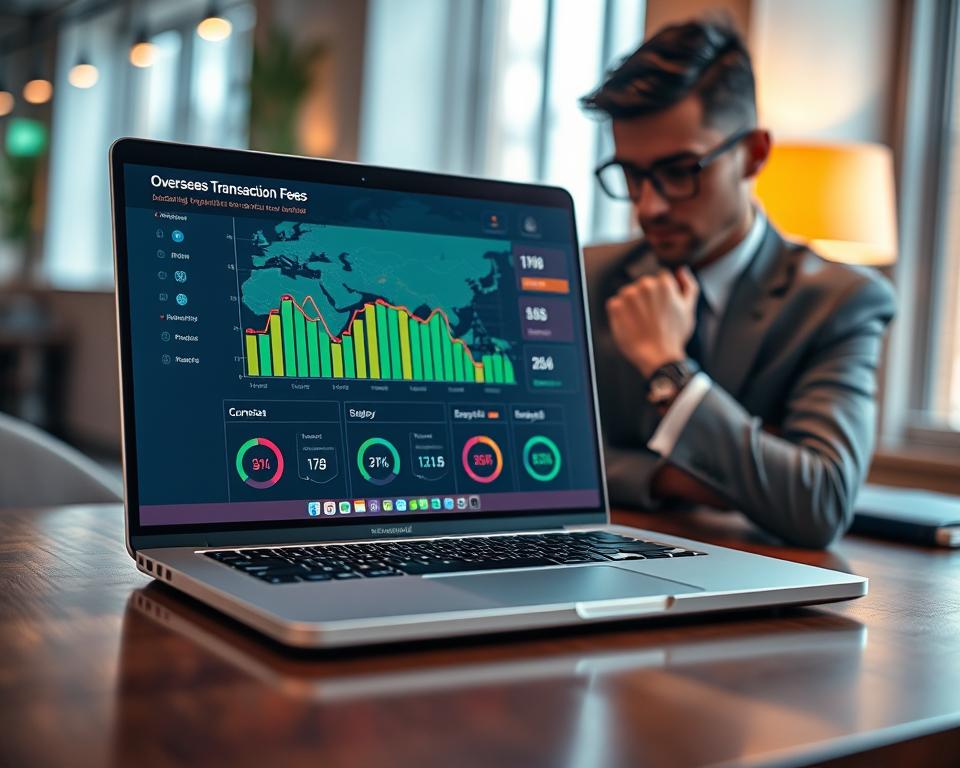
When you travel, small charges can really add up. Even a small 1%–3% fee on what you spend daily can shift your budget over time. It’s important to track these costs to plan better and avoid surprises.
How fees accumulate over time
Imagine making 20 purchases, each costing $50, with a 2% fee. This habit results in $20 in fees from just regular spending. It’s a clear example of how small, repeated charges can add up, rather than one big purchase causing the spike.
During a longer trip, the effect becomes more obvious. Spending $5,000 abroad with a 2% charge means paying $100 extra. In the long run, these FX fees can force you to stay under budget or cut back on activities.
There are hidden costs too. Fees from ATM operators, foreign ATM surcharges, and different currency conversions can up your spending. These can push the total cost of overseas transactions higher than just the basic fees from your card issuer.
Your choices make a difference. For example, travelers can save by using cards without foreign transaction fees or saying no to DCC at the checkout. Changing to a card with no fees for frequent trips can also reduce the long-term impact on your budget.
Here’s a simple checklist to keep fees low:
- Compare card fees before you travel.
- Choose local currency and decline DCC.
- Withdraw bigger amounts less often at ATMs to avoid extra fees.
How to avoid or minimize foreign transaction fees
Choosing the right card before you travel is key. A good card helps you dodge unexpected fees and makes budgeting easier. Apply early, let your issuer know when you’ll be abroad, and ensure the card’s features fit your travel needs.
Choose cards with no foreign transaction fee
Find a card that doesn’t charge foreign transaction fees. Capital One and Discover are good choices because they don’t have these fees for purchases. Charles Schwab’s debit accounts are also great for travel since they refund ATM fees and have no foreign transaction fees.
Get your card weeks before you travel to make sure it works. Tell your card issuer your travel plans to prevent a fraud alert. Also, check if your card works well in the places you’re visiting.
Consider the benefits versus the fees. Some travel cards with no foreign transaction fees offer great rewards but may have an annual fee. Think about whether the yearly fee is worth the benefits for short trips. Sometimes, a basic no-fee debit card is all you need.
| Card Type | Examples | Foreign Transaction Fee | Typical Perk |
|---|---|---|---|
| Credit (no FX) | Capital One Venture, Discover it | 0% | Points or cash back |
| Debit (no FX) | Charles Schwab Bank Debit Card | 0% and ATM fee rebates | ATM fee refunds worldwide |
| Premium travel cards no FX fee | Chase Sapphire Reserve (check current terms) | 0% on many cards | Priority Pass, travel credits |
Pick a card that fits your travel style. If you enjoy perks like lounge access, select a travel card without foreign transaction fees that offers enough benefits to outweigh the cost. For affordable spending abroad, choose a no-fee card that keeps costs low.
Always choose to pay in the local currency at checkout. This avoids extra fees from dynamic currency conversion. Save your receipts and check your statements after you travel to catch any surprise fees.
How to avoid or minimize foreign transaction fees
When you’re buying things abroad, making a simple choice at checkout can affect your bill. If merchants offer to charge in U.S. dollars using dynamic currency conversion, it might seem easier. However, this option usually has higher fees than standard network rates.
Choose local currency at point of sale
It’s best to always pay in the local currency. If you’re asked at the terminal, say you want to pay in euros, pesos, pounds, or the local money. Choosing local currency ensures the card network does the conversion. You’ll likely get better exchange rates from Visa, Mastercard, or American Express this way.
Decline DCC when offered
Make it a point to decline DCC. If a merchant wants to charge you in dollars, just say no thanks to DCC. Instead, confirm that you’ll pay in the local currency. This way, you avoid high merchant markups and let the network handle the conversion.
Use dynamic currency conversion avoidance as a habit
Always say no to DCC, even if you have a card without foreign fees. Avoiding DCC means fewer surprises on your bill. It also lets you fully enjoy the benefits of cards without foreign fees. Tip: Keep a reminder on your phone to “pay in local currency” for showing to cashiers.
What to do if DCC has already been applied
If you see a charge in dollars you didn’t choose, first talk to the merchant for a refund and ask to be charged again in local currency. If they don’t help, contact your card issuer. Explain the situation and ask what you can do to fix it.
Quick checklist for travelers
- When prompted, say you want to pay in local currency.
- Politely decline any offer for DCC.
- Use cards from Visa, Mastercard, or American Express for network conversions.
- Keep receipts to check exchange rates later.
How to avoid or minimize foreign transaction fees
When you travel abroad, the choices you make can affect the foreign ATM fees and card charges you pay. By planning ahead, you can ensure that your cash, exchange rates, and ATM access align with your budget. Mixing cash, debit cards, and certain services can minimize surprises when you withdraw money.
Use debit accounts that refund operator fees
Pick accounts that give back ATM fees. Charles Schwab Checking and Fidelity Cash Management refund fees from other banks’ ATMs around the world. This lets you use ATMs at local banks and avoid the high fees at private machines.
Find partner ATMs before you leave
Search for global ATMs that are partnered with your bank or network to avoid extra fees. Using these ATMs can help you dodge both foreign ATM fees and operator charges. Save their locations on your phone to avoid spontaneous, costly withdrawals.
Pre-purchase or top up multi-currency services
Think about using Wise or Revolut to secure a mid-market rate. Buying currency ahead of time or keeping a balance in the local currency cuts down on conversion fees and reduces your need to use expensive ATMs. Use these options for big expenses and refill them only as needed.
Balance cash and card use
Cards are your best bet for most spending because they usually have better rates than places like airport kiosks. It’s wise to have some cash for markets and tipping. But, try not to take out small amounts of cash at high-fee ATMs too often.
Quick checklist for fee control
- Open an account with reimbursed ATM fees before travel.
- Map partner ATMs in your destination city.
- Preload a multi-currency app for planned expenses.
- Decline Dynamic Currency Conversion and pay in local currency.
- Avoid airport exchange kiosks with steep markups.
| Option | Typical Benefit | Watch For |
|---|---|---|
| Debit with reimbursed ATM fees | Refunds third-party ATM operator charges; low overall withdrawal cost | Daily withdrawal limits; bank network availability |
| Partner ATMs | No surcharge at partner locations; predictable access | Limited coverage in remote areas; need location planning |
| Wise / Revolut preloaded balances | Mid-market rates; lower conversion markups | Fees for large ATM withdrawals or premium features |
| Credit cards with no foreign transaction fee | Good rates for purchases; fraud protection | Cash advance fees and higher APR for withdrawals |
Picking the right card for your travel style
When you’re often on the move, you’ll want a wallet that’s just as active. Pick cards that reduce costs and increase your comfort while traveling. They should be widely accepted and offer benefits perfect for your travel habits.
Frequent travelers need a travel credit card with no foreign transaction fees and great perks. Visa, Mastercard, and American Express cards are usually accepted globally. Look for benefits like airport lounge access, car rental insurance, and protection against travel delays.
Consider premium and mid-tier cards from companies like Capital One and Citi. They could be your top choice if the rewards and travel credits cover the annual fees. Balance the yearly cost with perks like credit for travel expenses, status upgrades, and more points for flights and hotels.
Examine extra benefits carefully. Features like trip cancellation insurance and lost luggage compensation offer real value. Make sure to check if the card offers solid concierge services or global help before you decide.
Compare the rewards and partner options next. Cards that let you transfer points provide freedom to choose better flights or hotels. Focus on cards that give lots of points for airfare and stays if you trade points for travel a lot.
Lastly, make sure the card is accepted where you go the most. Test the customer service, read up on it, and do small tests abroad. A card that saves on foreign fees and works well will eventually become your go-to as a frequent traveler.
Picking the right card for your travel style
If you travel a few times a year or shop from international websites, you have different needs than frequent travelers. You want a card that is simple to use, has low fees in the U.S., and protects you during international purchases. Picking the right card means no surprises when shopping online internationally and helps you stick to your budget on trips.
Practical card features for light travel and e-commerce
Search for cards that don’t charge an annual fee and are upfront about foreign transaction fees being waived. Cards like the Capital One SavorOne or the Wells Fargo Active Cash are great since they offer good value and don’t charge extra for purchases made abroad. A policy that removes foreign fees means you won’t face the usual 1%–3% penalty that many cards include.
How to handle vendor currency options
If given the choice, always pay in the local currency of the vendor, not in your home currency. This avoids the extra costs from dynamic currency conversion (DCC) and bases your charges on the card network’s rate. This is especially important for online purchases from other countries where DCC can sneak in extra charges.
Alternatives to branded credit cards
Prepaid multi-currency cards and fintech options like Wise are good for occasional overseas spending. They allow you to lock in exchange rates early and lower the costs from currency markups. You can use these for big purchases abroad or for added security along with your main travel card.
Buying strategy and statement review
Keep an eye on your card statements to understand how international charges are recorded. If there’s a line for conversion, check if it’s the network’s rate or an added fee from the issuer. Saving receipts from your online buys abroad will help you challenge any surprise charges later.
Final selection checklist
- Confirm no-foreign-fee for shopping and no annual fee where possible.
- Prefer cards with clear dispute and fraud protection for e-commerce.
- Use local currency at checkout and consider a prepaid multi-currency option for large or frequent purchases.
Practical tips for U.S. travelers at point of sale and online
Travel involves important small tasks to protect your finances. Checking everything before you leave saves time and prevents problems overseas. Follow these steps to ensure smooth card use and avoid unexpected statement charges.
Tell your issuer about travel plans
Inform your bank about your travel—where and when you’ll be going. This tells banks your purchases are legitimate and not fraud. Companies like Chase, Bank of America, and American Express let you set travel alerts in their apps or websites.
Use the app to set a travel alert for quicker processing. It shows your card should be used abroad, helping avoid fraud-related blocks at shops or cafes.
Have international contact numbers for your bank ready. Also, carry a spare card that doesn’t charge for international transactions. Store bank numbers in your phone and email to quickly solve card issues.
Practical tips for U.S. travelers at point of sale and online
Check your card statement after shopping abroad. Look for any unexpected charges. It’s a quick way to spot and address problems early.
Review statement details promptly
Match your receipts with the U.S. dollar amounts on your statement. See if the currency conversion matches up. For Visa, Mastercard, or American Express users, pay attention to the conversion rate.
Look for any foreign exchange (FX) fees listed separately. If you see something off, keep the receipt and any dynamic currency conversion (DCC) slips. These documents are important if you dispute charges later.
If you find charges you can’t explain, contact your card issuer immediately. Provide receipts and ask how long resolving the issue will take. Take notes of your conversation and any reference numbers.
Always check your statements for foreign transaction fees. Knowing how your bank lists these fees can help you catch mistakes quicker. This applies especially to cards from Chase, Capital One, Citi, or Bank of America.
When disputing charges, keep it simple and straight to the point. Mention the amounts and why they’re wrong. Ask if they can give a temporary credit during the investigation.
Regulatory and issuer disclosure expectations
When you get a new card or use it in another country, expect to see clear fee notices. Laws and card rules say issuers must show fee info in their written materials. Always check these sections before traveling.
The cardholder agreement and rate schedules list all rates and fees. Along with online posts, these documents clearly disclose fees. The foreign transaction fee is usually shown as a percentage of each transaction.
Your statements will list the name of each store and what you paid in U.S. dollars. You’ll also see any foreign transaction fees listed separately. Visa, Mastercard, and American Express make sure you see the dollar amount and store names clearly.
Look at your card’s terms for info on currency conversion. These terms tell you who decides the exchange rate and if there’s an extra fee.
When comparing cards, examine the fee disclosures closely. Spot the language about fees to quickly notice charges and argue any surprises.
Where fees must appear
Fee details must be in cardholder agreements, rate schedules, and on issuer websites. For mailed or emailed bills, details must make FX charges clear.
Conversion amounts and merchant names must be easy to see when transactions post. This info helps you check your charges against your receipts.
If you can’t find the fee details online or in print, call customer service. Keep a copy of your card terms for any disputes or complaints.
Regulatory and issuer disclosure expectations
Regulators want card issuers to make fees clear when you’re abroad. Terms should be easy to understand to help you notice fees that shouldn’t be mixed. If your bill shows just one fee, ask for a detailed list to avoid shocks.
Issuer practices to watch
Be careful of unclear wording that hides extra charges by combining them. This can make it tough to spot hidden fees on your bill. Request a detailed example of how charges show up from your issuer.
Watch out for extra charges from merchants, like when they offer to charge in your home currency. Saying yes to this can lead to extra costs not shown by your card issuer. Always choose to pay in the local currency if you can.
Look into ATM policies well. Some banks don’t charge their own fees but won’t cover fees from the ATM’s end. Make sure to check if your card covers ATM fees and if it includes the ATM owner’s fees.
Understand how refunds work for purchases in a foreign currency. Not all issuers give back the same exchange rate, leading to losses that seem like hidden fees. Find out how refunds are handled and if they’re detailed.
Check the terms of prepaid travel cards before adding money. Some cards have conversion fees at different stages, which might not be clear at first. Look at different issuers’ terms to find the most transparent options.
If you see charges that don’t make sense, talk to the issuer’s dispute team and keep your receipts. Good records help you argue against wrong fees and push for clear disclosures when your statement is vague.
Summary and next steps to protect your wallet
Most card issuers charge 1%–3% for purchases in another currency. This surcharge is aside from a network currency conversion fee and DCC markups. So, you’ll see different charges on your statement. Understanding the fees can help you spot and avoid extra costs.
To dodge these fees, get a card that doesn’t charge them before you travel. Look at options like Capital One, Discover, or a Charles Schwab Checking account. These accounts refund ATM fees. Also, consider using services like Wise or Revolut and ATMs that don’t charge extra, to save on cash expenses.
At the store, always pay in the local currency to avoid higher costs. Tell your bank about your travel plans. Keep an eye on your account and save receipts to challenge unexpected fees. Look out for currency conversion and transaction fees on your statements to question any odd charges.
By choosing the right cards, avoiding DCC, and using friendly ATMs, you can cut down on fees. Keeping on top of your statements helps, too. These easy steps can protect your wallet and make costs more predictable when you’re abroad.