
ads
Inside What Nobody Tells You Before You Download
The dating app market in 2026 looks simple from the outside — you download, create a profile, and start using it. But what happens inside each platform is far more complex than any download page reveals. Algorithms that decide who you see, business models that influence your behavior, and design differences that completely change the type of experience you’ll have.
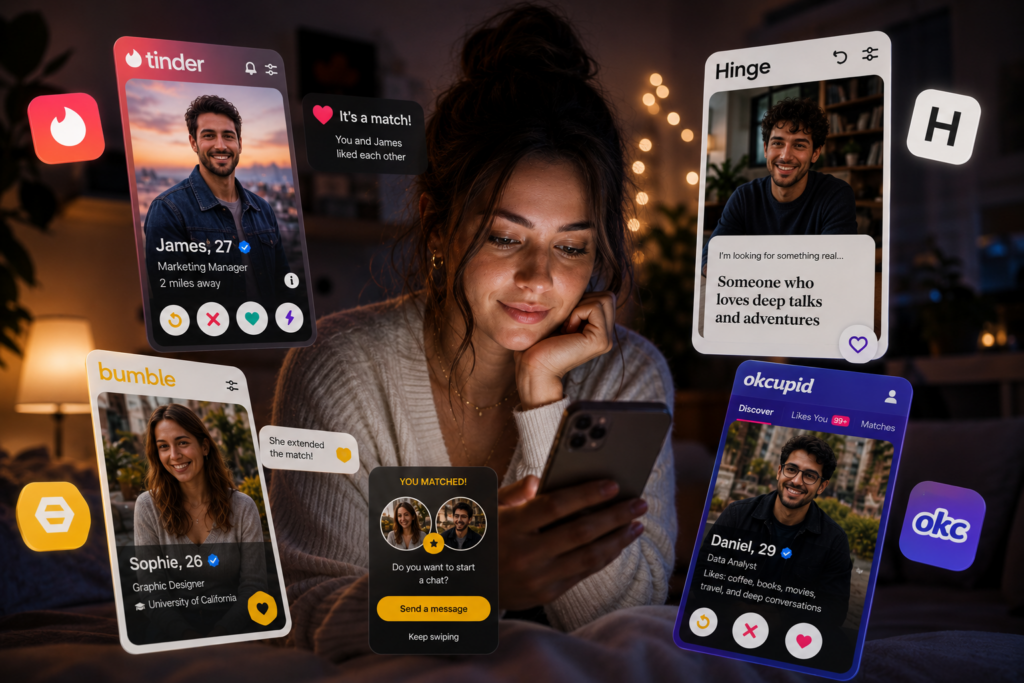
Most people choose their app based on two criteria: what their friends use and what’s trending at the moment. Neither is a good filter. The right app depends on what you’re looking for, the environment where you feel most comfortable, and how much you understand about how each platform was built — and for what purpose.
This article opens the hood on each of the main apps of 2026 and shows what really sets them apart — the mechanisms beneath the surface that shape your experience without you even noticing.
How Algorithms Decide What You See
Before talking about each app, there’s a topic that affects all of them: the algorithm is not neutral. Each platform uses its own system to decide which profiles appear for you — and that system isn’t just trying to connect you with compatible people. It’s trying to maximize the time you spend on the app and, in many cases, the likelihood that you’ll subscribe to a paid plan.
What algorithms monitor in the background:
- Time spent on each profile before deciding to like or pass.
- Response rate in conversations you start or receive.
- Behavior after matches — whether you start conversations and how long it takes.
- Interactions with premium features to identify when to show you subscription offers.
- Usage patterns and how frequently you open the app throughout the day.
Understanding this puts you in a far more advantageous position than most users who operate on autopilot.
Tinder: What Changed and What Stayed the Same
The Tinder of 2026 is different from the Tinder of 2019 — but its core logic remains: volume, speed, and quick visual decisions.
What improved:
- Smart Photos that automatically reorders your photos based on which one generates the most likes in real time.
- Tinder Explore that organizes users by shared interests, creating context beyond physical appearance.
- Selfie verification that significantly reduced profiles using stolen photos.
- Enhanced Travel Mode that lets you explore users in other cities without exposing your precise location.
What remains a point of concern:
- Aggressive freemium model where free users have artificially limited visibility to push subscriptions.
- Design still optimized for volume — fast swiping remains the heart of the experience.
- Data policy that involves sharing with Match Group partners that most users are unaware of.
Makes the most sense for people in large cities who want diversity of options and are comfortable with a fast-paced experience.
Bumble: Far More Than the Women’s Rule
Bumble is often reduced to a single feature. But in 2026, the platform has become much more than that.
What really sets Bumble apart today:
- Opening Moves — any gender sets a question or prompt that the match responds to in order to start the conversation, reducing the pressure of the first message.
- Private Detector with AI that automatically blurs unsolicited explicit photos before the recipient views them.
- Video selfie verification that compares the person’s face in real time with the profile photos on file.
- Snooze Mode that completely pauses the profile without deleting the account.
- BFF Mode that extends the app to friendships within the same platform.
What it still doesn’t solve:
- 24-hour window for the first message in heterosexual connections can cause missed matches due to timing.
- Smaller user base than Tinder in medium and small cities, which limits options in certain regions.
Hinge: The App That Changed What a Match Means
Hinge completely eliminated swiping — and in 2026, that decision proved to be right. The app has the highest rates of conversations that evolve into real in-person meetings among all major platforms.
What makes Hinge structurally different:
- You like specific elements of a profile — a response, a photo, a story — and comment directly on that element, creating a concrete conversation starter.
- Mandatory prompts that reveal personality and values in ways that photos alone can never convey.
- “Your Turn” clearly indicates whose turn it is to respond, measurably reducing ghosting.
- We Met asks after a period whether the meeting happened and how it went, feeding the algorithm with real quality data rather than just quantity.
Table 1: What Each App Really Prioritizes
| 📱 App | ⚙️ What the Design Prioritizes | 👥 Who Predominates | 🎯 Typical Outcome |
|---|---|---|---|
| Tinder | Volume of decisions per minute | Diverse profiles with varied intentions | Casual to medium-term connections |
| Bumble | Respectful and safe environment | Users who value safety and respect | Medium to high quality connections |
| Hinge | Depth of connection | People seeking serious relationships | Real in-person meetings |
| OkCupid | Compatibility by values | Reflective, relationship-oriented users | High compatibility when it works |
OkCupid: The App That Knows You Before You Know Anyone
OkCupid has in 2026 a feature that no other major app has replicated: a compatibility question system that ranges from everyday preferences to fundamental life values.
What makes OkCupid different in practice:
- Visible compatibility percentage based on answers both users gave to the same questions.
- Granular search filters — political views, diet, plans for children, and dozens of other criteria.
- Profile as a statement of intent — anyone who invests time answering questions is signaling seriousness.
- Fairer free visibility than Tinder, with fewer artificial restrictions for non-subscribers.
Table 2: The Right App for Each Situation
| 🧩 Situation | 📱 Recommended App | ✅ Why It Works | ⚠️ What to Watch For |
|---|---|---|---|
| Large city, want maximum options | Tinder | Highest user density on the market | Configure privacy settings from day one |
| Want an environment with less harassment | Bumble | Structural design reduces inappropriate behavior | Activate identity verification immediately |
| Tired of conversations that go nowhere | Hinge | Format forces genuine engagement from first contact | Invest in a complete profile with honest prompts |
| Want deep compatibility by values | OkCupid | Most sophisticated question system available | Read the data policy before signing up |
What Apps Don’t Do for You
No platform replaces the judgment you bring into it. The app organizes the environment — you decide the quality of the experience.
Practices that apply to any app in 2026:
- Use a dedicated email for sign-up with no connection to personal accounts.
- Activate all available verification features from your very first login.
- Never use your precise location — always choose the city or broad region option.
- Define your intention clearly in your profile — clarity attracts users with aligned intentions.
- Search the app name alongside “data breach” before signing up — incident history is public.
The Difference Nobody Sees Until They Use It
What really sets the most used dating apps of 2026 apart isn’t on their marketing pages — it’s in the accumulated experience of the people who use them. And what that experience consistently shows is that the right platform completely changes the outcome. Not because it’s magic, but because it was built for the same goal you have.
Related topics: how dating app algorithms work, what experts recommend in 2026, signs that a profile is fake, and how to configure privacy before creating any account.